

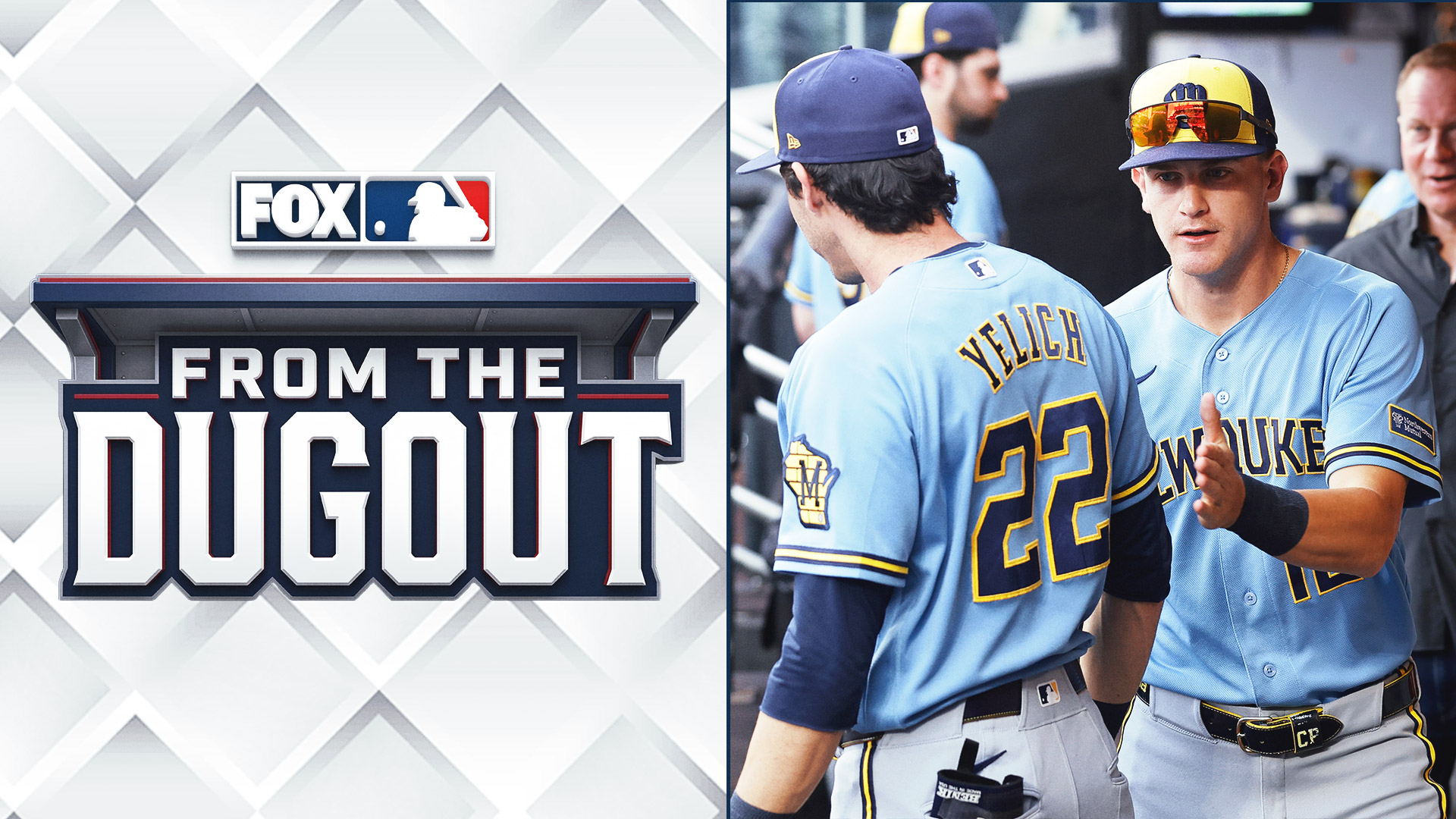

NEW YORK — It’s the fifth inning at Citi Field. The Brewers are leading the majors in wins, and they’re leading this particular Tuesday night game against the Mets by a run when Cooper Pratt pops one up to shallow right field.
Pratt stood in the box and briefly looked up at the ball sailing beyond first base and toward the foul line. After a beat, he jogged to first base. The ball dropped between three Mets fielders, and Pratt took a big turn, thought about going to second, but ultimately stayed put. Behind him, Brewers first base coach Spencer Allen was visibly upset. But as Pratt turned around and stepped on the bag, Brewers skipper Pat Murphy had already sent David Hamilton out to run for him.
Milwaukee’s rookie shortstop, who recently signed an eight-year contract worth just north of $50 million, was yanked in a one-run game in August.
“It will never happen again,” Pratt said after the Brewers’ extra-inning loss that he watched from the dugout. “I’ve got to be better. It’s stuff that can’t happen. It’s not winning baseball.”
(Photo by Orlando Ramirez/Getty Images)
In the third inning, Pratt also twice failed to execute a bunt attempt. So, Murphy’s decision to bench Pratt was supposed to be a lesson about focus. The real lesson might be that Milwaukee has been teaching this same class for a while now. The final exam is still the one they failed last October.
The Brewers (83-51) have the best record in baseball. Again. They had it last year too, finishing at 97-65, and it meant nothing once the Dodgers swept them out of the NLCS.
So a 22-year-old shortstop getting benched for not immediately jogging to first and failing a bunt attempt isn’t really about Pratt. It’s a proxy for the heavy expectations that are hanging over a winning organization that’s routinely punching above its weight. It’s about accountability.
“I’m not trying to be Johnny hard-ass here,” Murphy said. “It’s just, for a young player coming into the league, you have to build habits.”
(Photo by Mary DeCicco/MLB Photos via Getty Images)
Does accountability during a Tuesday night in August actually translate into a different result in October? Or are Murphy’s Brewers just doing what Murphy’s Brewers always do, right up until the games matter most?
Ironically, Hamilton – Pratt’s replacement — made a throwing error in the 10th inning that allowed the Mets to walk it off with a victory. So it was the rookie’s replacement who made the costlier mistake. Murphy later said, after watching the video, that Pratt’s lack of hustle on the bloop single wasn’t as egregious as he initially perceived.
“It’s for the player and the team,” Murphy said. “I love [Pratt] and I believe in the kid immensely. But he’s got to be a player who does those things. He’s not going to hit 30 homers at this point in his career. He’s a great defender and a really capable offensive player, and he can’t have that. It’s just not tolerated by anybody, and it sends a message to everybody else, too. You’ve got to run.”
(Photo by Lawrence Iles/Icon Sportswire via Getty Images)
Murphy has a reputation of benching players or yanking them mid-game to enforce things like hustle and fundamentals. He once benched right fielder Sal Frelick for missing the cutoff man. This year, he pulled left-hander Robert Gasser mid-count after he fell behind against Randy Arozarena. This isn’t new. Murphy has no tolerance for physical or mental lapses.
Still, Pratt’s benching was received differently than some of the other examples. This isn’t May. It’s August in a division race that’s all but decided. The Brewers are getting prepared to battle in October, aiming to reach the World Series for the first time since their lone appearance in 1982. The conversation in the clubhouse afterward was just that. After Pratt handled his mistake like a pro in front of the cameras, his teammates reiterated that Murphy’s discipline was more about World Series preparation.
“In my personal opinion, I don’t really think it had a whole lot to do with not going to second there,” unofficial Brewers captain Christian Yelich said on Wednesday. “I think it was a culmination of events with a greater goal in mind for six weeks from now, if you want my honest opinion on it.”
Disciplining a lack of hustle and focus earlier in the season is easier to do. But disciplining approach and performance under playoff pressure is much more difficult, and that’s what cost Milwaukee last October.
(Photo by Harry How/Getty Images)
The Brewers were bounced in four games by Los Angeles in a painful NLCS sweep last year. There were no signature moments, just a complete absence of the Brewers’ brand of baseball. That typically includes no power, plenty of runs, lots of walks, and a high contact rate. Murphy and the Brew Crew, after being eliminated from the postseason, claimed they were emotionally “zapped” by their dramatic and demanding NLDS against their division-rival Cubs.
“It was a heavy series. It was a long series. It was a hard series,” Brewers first baseman Jake Bauers told me of last year’s NLDS against the Cubs. “We celebrated it hard. And then two days later, we had to play the Dodgers. What I learned, personally, was that we need to treat these games, regardless of who we’re playing, just as games. We can’t lose sight of the ultimate goal.
“But I think along the way, you kind of get wrapped up in how emotional it was. And then there’s not enough time to recover from that, recharge. So you lose focus a little bit. Once you lose focus in the playoffs, it’s near impossible to recapture that.”
(Photo by Michael Reaves/Getty Images)
The Brewers are doing it again this year. They’re preaching focus and accountability all season, and it’s not clear what will actually stop them from being outclassed by star power and playoff experience in a seven-game series. Hustling out of the box is not the same as hitting home runs off the best rotation in baseball.
We didn’t get to see Milwaukee stick to their usual winning approach against the reigning champions last year, since they were emotionally drained by the time they faced the Dodgers. If they meet again this October, the Brewers have to demonstrate that grinding out at-bats, being last in home runs, near the top of the league in strikeouts thrown, and their small-ball identity can actually hold up against elite bullpens. We already know their brand of ball works against a random Tuesday rotation arm in August.
“I don’t think you can prevent it or play any less intensely,” Murphy told me of how the Brewers can avoid being exhausted after the first round of the playoffs. “But I think awareness is big. You don’t plan for it now. It’s just there. So when the time comes, be prepared.”
Are there reasons to believe things will be different this postseason?
Their pitching staff has remained elite despite trading away a key piece in Freddy Peralta. Emerging arms like NL Cy Young favorite Jacob Misiorowski have stepped up, and it will be fascinating to see how opposing hitters approach his relentless triple-digit heaters in October. The rotation’s 3.47 ERA is ranked third in the majors behind the Yankees and Tigers. The bullpen’s 3.29 ERA is also ranked third in MLB.
But when president of baseball operations Matt Arnold had the chance to give the Brewers the undisputed best rotation in baseball by trading for Tarik Skubal, he blew it. Instead of being super aggressive, putting their top farm system to use at the trade deadline, Arnold & Co. settled for right-hander Dustin May, while Skubal went to Hollywood. With Skubal and Misiorowski leading the pitching staff, the Brewers would’ve become the favorites to win the World Series.
(Photo by Orlando Ramirez/Getty Images)
The organization, at least, is a full year removed from the Dodgers loss, with lessons learned, and Murphy, the back-to-back NL Manager of the Year, has had plenty of time to recalibrate what it means to be playoff-ready. The clubhouse has fully bought in to Murphy’s team culture, evidenced by Pratt’s display of accountability, and his Brewers teammates who spoke to the rookie in the dugout immediately after he was benched.
“Coming from a guy who’s been benched multiple times by Murph, it’s not always 100 percent directed at the person getting benched, and there’s a thousand different reasons,” Frelick said on Wednesday. “From the past, when I’ve seen guys get benched, including myself, it’s usually when a few days have piled on of not [playing] to that standard. A message needs to be sent. I don’t think anybody was surprised when it happened last night.”
Pratt says it won’t happen again. That’s fine, but the Brewers said something like that about themselves last October too, and it happened again anyway, just in a different form. The only version of this story that matters is the one written in the Fall Classic. Everything before that is just Milwaukee grading its own homework.