CITIZENS BANK BALLPARK (Philadelphia) – Talk about a star-studded cast of sluggers.
This year’s Home Run Derby was set against the backdrop of a sea of red-jerseyed Phillies fans that overtook Citizens Bank Park to watch their hometown sluggers represent their city.
The lineup consisted of the Red Sox’ Willson Contreras, the Cardinals’ Jordan Walker, the White Sox’ Munetaka Murakami, the Rays’ Junior Caminero, the Yankees’ Ben Rice, the Royals’ Jac Caglianone, and finally, the Phillies’ Kyle Schwarber and Bryce Harper.
Bryce Harper was one of two Phillies participating in the Home Run Derby in their home ballpark. (Emilee Chinn/Getty Images)
Mike Trout’s prediction of who would win the Derby was, without hesitation, “Harp.” But he was quick to throw in some support for Caminero, too, saying, “But I think Junior might. Junior’s nice.” Let’s just say Trout is exceptionally better at hitting baseballs than he is at forecasting the future.
Here are my takeaways from yet another exciting Home Run Derby:
1. Walker, 12. Schwarber, 11.
Schwarber advanced to the finals after knocking out Contreras in the semifinals. He was made for this. On the biggest stages under the brightest lights, Schwarber is a showman.
In the final round, Schwarber was so in the zone that he even started walking to first base after his 10th home run of the final round before returning to the plate. After each swing and every ensuing home run, his Phillies All-Star teammates in Harper, outfielder Brandon Marsh, starter Jesús Luzardo and closer Jhoan Duran spilled onto the field and raised their arms as they hyped up Schwarber.
Jordan Walker after a home run during the semifinals. (Emilee Chinn/Getty Images)
When Scharber hit his seventh home run with five swings still remaining, Harper declared to his teammates, “It’s over.” He finished his Derby with 11 home runs in the final round, and then it was up to Walker to try and spoil the storybook ending in front of 43,000 Phillies fans.
And spoil he did.
Walker got off to a slow start in the final round, but then he homered five straight times to tie Schwarber at 11 apiece. With his final swing, Walker sent it to left field, securing his 12th and final home run.
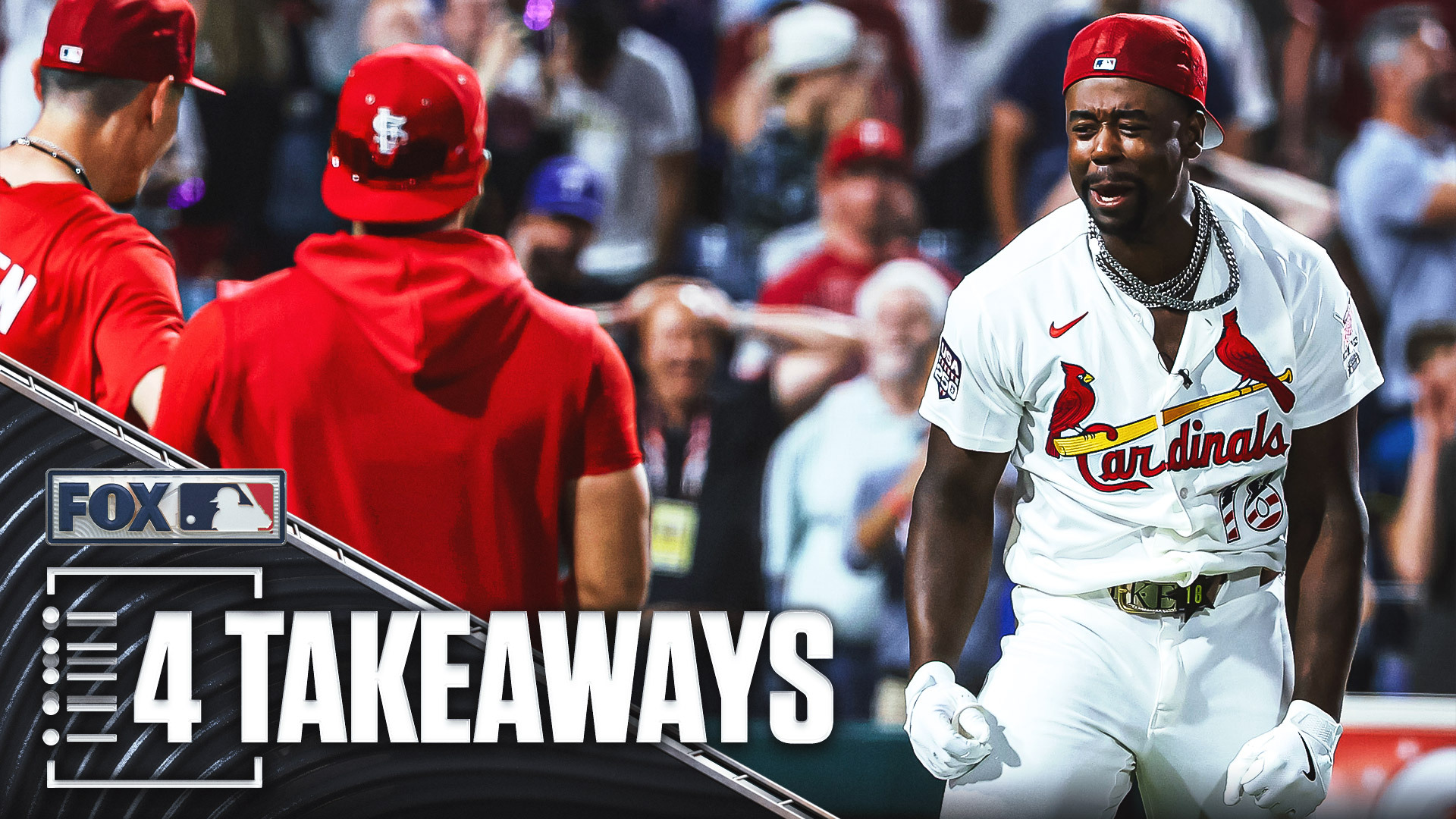
Walker became the first-ever St. Louis Cardinals player to win the Home Run Derby.
“The homers that I hit, I’m more easy. I’m not forcing it,” Walker said after winning it all. “When I do, I start missing the ball. So in a Home Run Derby, it’s a different approach. I wanted to swing easy, and see what happens.”
Walker’s voice was raspy as he sat on the dais in the Phillies press conference room wearing a backwards red Cardinals hat and a black bomber jacket. He said he didn’t mind disrupting Schwarber and Philly’s fairytale ending. He viewed getting incessantly booed in the final round as an excellent experience for what he wants to accomplish next.
“My goal is to win a World Series,” he said. “I feel like it’s going to happen then too. So I’m going to face it at some point in my life. I think I’d rather face it now.”
2. Hometown Heroes Battle It Out
The first round came down to the two Phillies. Only four of the eight participants advanced to the second round, and after Contreras and Walker each cranked 13 home runs and Caminero hit 12, there was only one spot left. Schwarber and Harper were the final two sluggers to step into the box in the first round.
Schwarber, who was in the batting cage getting practice swings in before his name was called, got off to a rough start. He started 0-for-5, and the home crowd started to get nervous. Schwarber shook it off, told his throwing partner, Phillies assistant hitting coach Rafael Pena, “We’re good.” And he stepped back into his batting stance.
Suddenly, Schwarber went on a ridiculous run, slugging 10 home runs in his final 14 swings.
Kyle Schwarber put on a show for the home fans in Philadelphia. (Drew Hallowell/MLB Photos via Getty Images)
Then it came down to Harper. He needed 11 home runs to surpass his teammate and advance to the second round. If they tied, then Harper held the advantage because he hit a home run farther than Schwarber did. Alas, Harper fell short with eight homers and was eliminated from the Derby after the first round.
In 2018, the Nationals’ Bryce Harper beat the Cubs’ Kyle Schwarber in the finals to win the Home Run Derby. Perhaps it was only fair that Schwarber was the one who knocked Harper out this year.
“I wanted both of us to move on,” Schwarber told MLB Network’s Lauren Shehadi on the field afterward. “If I would’ve done my job a little bit better, probably would’ve had a better chance for both of us to move on. But super proud of him and what he means to us as a team, us as an organization, and us as Philadelphia. We’re lucky to have No. 3 on our side, I’ll tell you that.”
3. New Format, More Takes
This year’s Home Run Derby introduced a new swing-based format that eliminated the timer, which had been in place since 2015, and the bonus round. Eight players still made up the field, but instead of aiming to hit as many home runs as possible in a timed round, participants started each round with a set number of swings.
The first round had 20 swings, the second round had 15, and the third and final round also had 15. The one caveat: if a player homered on his final swing of a round, he can keep swinging until he fails to hit one out.
For those of us who have been watching the Home Run Derby for a long time, it was pretty jarring to see the timer disappear on Monday. It took some time to adjust to the flow of the new swing-based format, which in general felt more laid-back without the pressure of the clock ticking.
It also led to more takes.
Since only their swings counted, players were free to take as many pitches from their throwing partners as they wanted. Contreras was putting on a show in the first round, slugging 13 home runs in 19 swings. Then, when he had one final swing remaining, he took four pitches before he saw one he wanted to hit. By the time he took his fourth pitch, the crowd venomously booed him, because they wanted to see some action.
This back-and-forth of taking pitches and getting booed continued in the semifinals round, but as usual, the always-fiery Contreras didn’t seem to mind the noise.
4. Rice Doesn’t Cook
Historically, the Yankees have performed well at the Home Run Derby. The Bronx Bombers are tied for the most Derby champions in MLB history with four individual winners: Aaron Judge (2017), Robinson Cano (2011), Jason Giambi (2002), and Tino Martinez (1997).
So, the pressure was on for Rice, the latest Yankee to participate in the Derby, to go the distance.
But Rice didn’t cook on Monday night. It took him a long time and too many swings to get into a groove, and by the time he did, he only hit seven home runs, which was the worst performance out of all the contestants.
No matter the final result, it was clear that Rice had too much fun participating in his first-ever Home Run Derby. During pre-Derby introductions, Rice received the loudest boos out of all eight participants from the Philly crowd. Rice loved it. He laughed hysterically hearing the boos and shouted, “Bring it on.”
When Rice finished the first round, red in the face and completely exhausted, he smiled and hugged his dad, his throwing partner, before walking off the field.
“The boos were crazy, especially in the opening ceremony,” Rice said. “It was so cool. I always like to say, ‘They don’t boo nobodies.’ It was just really cool to have them rain down on me, even in the round, too. That was fun.”
WHAT YOU SHOULD READ NEXT
Mike Trout is back at the All-Star Game, but the path wasn’t easy.